
I am often the first to acknowledge the familiar adage: “change is the only constant.” Yet my quotidian observation of shifts in the natural world seem to herald more dramatic change to come, and not beneficial change for all the interconnected beings in my ecosystem, my family of being.
As I begin writing this essay, on a sultry summer day in July 2026 near my home in Annan, Ontario, I can feel the subtle grit of smoke on my tongue and at the back of my throat – smoke carried across North America on the jet stream from wildfires burning on the western side of the continent. The new “smoke watch” map featured on the Weather Network further alerts us to this ongoing impact on our air quality and clear skies.

Also, today, I saw two prehistoric-looking Sandhill Cranes fly over our home – these two exotics have taken up residency in a pasture near our house. This is the first time we have seen these birds in our local environs—are they displaced by smoke or expanding their habitat? The increased bounty on the heads of coyotes locally is resulting in a safer ecosystem for these large birds—we certainly have lost count of the rabbits proliferating in our yard this summer.
Recently, I saw a Facebook post by a friend questioning why, after a long drive from Kitchener to Barrie and back, on a hot humid day, there is no evidence of bugs on the windscreen of his car. I remember the days when, on a road trip, you would occasionally need to pull over and clean the windshield of insect splatter.
“We are no longer part of the garden – we have expelled ourselves from the realness of experience just like the Biblical expulsion from Eden”
Thinking of bugs, I am encouraged that each night this summer, just after sunset, we are seeing the fleeting shadows of bats swoop over the lawns around our house eating insects – for so many years those bats were entirely missing in the local environs due to a near-extinction event caused by an imported fungus that disrupted their winter torpor. Bats need to be able to feed, and we appreciate that they keep the mosquito count lower. I love their mysterious, evanescent presence along the edges of my vision field.
Today, at this point at the peak of summer, I am also anticipating with dread the day when the local farmer will inevitably mow down all the milkweed, wildflowers, thistles, and grasses that line the country lane where we let our dog run. This regular cutting back may, on the surface, seem like good stewardship of the lane, but it obliterates habitat for Monarch and Swallowtail butterflies.
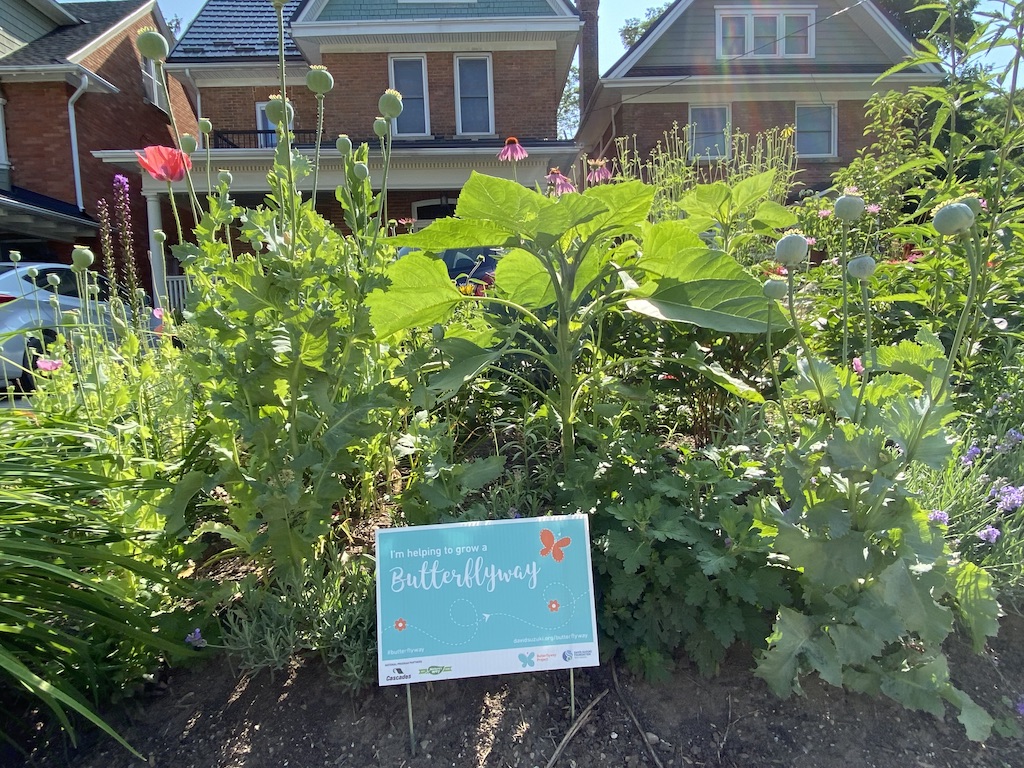
I have been counting the Monarch caterpillars that I have seen subsisting on those Milkweed spires – they will all be gone after that relentless blade passes. I have great concern for the roosts of wild turkeys, the colonies of mice and moles, even more for turtles and rabbits that will be traumatized by this catastrophic passby. Can’t we just let it be? The trauma of this catastrophic mowing hits me hard and resonates deeply as a metaphor for our times as agencies like the Centre for Biological Diversity predict over one million species are on track for extinction in the coming decades (1).
These random observances fuel my growing unease and interest to learn more about the potential to change the system and my role in the cause and occurrence of such events that I have described. My human perspective places me at the centre of a rich and diverse network of relationships – my heart knows that I do not exist without all the other living beings to which I am connected. My wish is that all beings are happy, all being are healthy, and all beings are safe from harm.
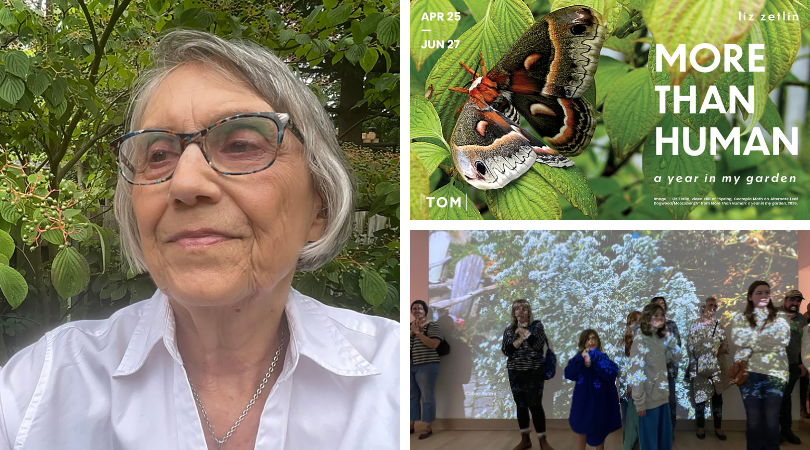
These reflections bring me back to Liz Zetlin‘s thoughtful and timely exhibition, More Than Human: A Year in My Garden, recently presented at the Tom Thomson Art Gallery in Owen Sound. In visual imagery, sound, and video, Zetlin offered visitors the opportunity to examine up close the myriad species of plants, insects, birds, and animals that live in her city garden in Owen Sound. This garden is a small haven where the artist cultivates native plants and fosters a hospitable environment for pollinators, birds, and the other creatures that assume residence there.
While the garden is a cultivated human pleasure domain, it is also a rich space to observe and get acquainted with other species. In his book called Second Nature: A Gardener’s Education (2), American journalist and author Michael Pollan says: “The garden suggests there might be a place where we can meet nature halfway.” Zetlin’s urban garden backs onto the Sydenham River and is mere steps from the Tom Thomson Art Gallery that hosts her evocations of it. Proximity to source, yet universal in messaging.
For decades, the artist, poet and writer, Elizabeth Zetlin has been creating engaging experiences that advocate for the natural world. Her adept command of various artistic disciplines allows her to draw upon poetry, photography, video, installation, sound, and music to create an environment for reflection.
A garden is a place to stop, to escape and find repose amid the beauty of nature. The exhibition that she has created is a similar oasis but with a not-so-subtle urgent message to take notice of what may have been previously overlooked.
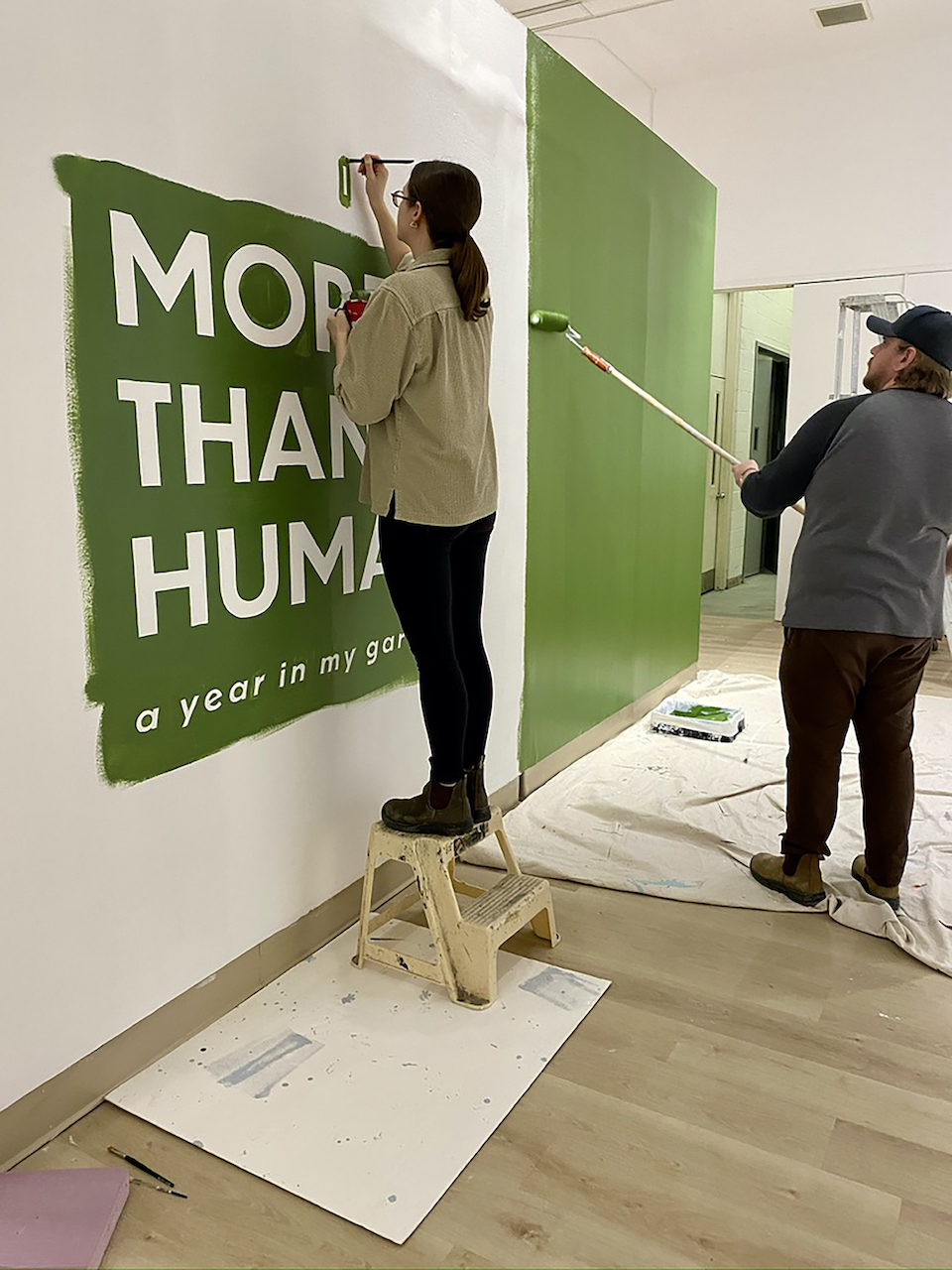
As we enter the gallery, Zetlin has set the stage for a contemplative approach to the work. The first passageway includes large texts hand-painted on the wall in a naturalistic, cursive script. Texts describe the plants Stiff Goldenrod and the New England Aster from Lorraine Johnson and Sheila Colla’s Garden for the Rusty-Patched Bumblebee (3) expounding on each plant’s symbiotic relationship with larva and pollen specialist bees. These paragraphs include various names for the plants including traditional names in Anishinaabemowin and the scientific genus and species in Latin, as well as the common parlance.
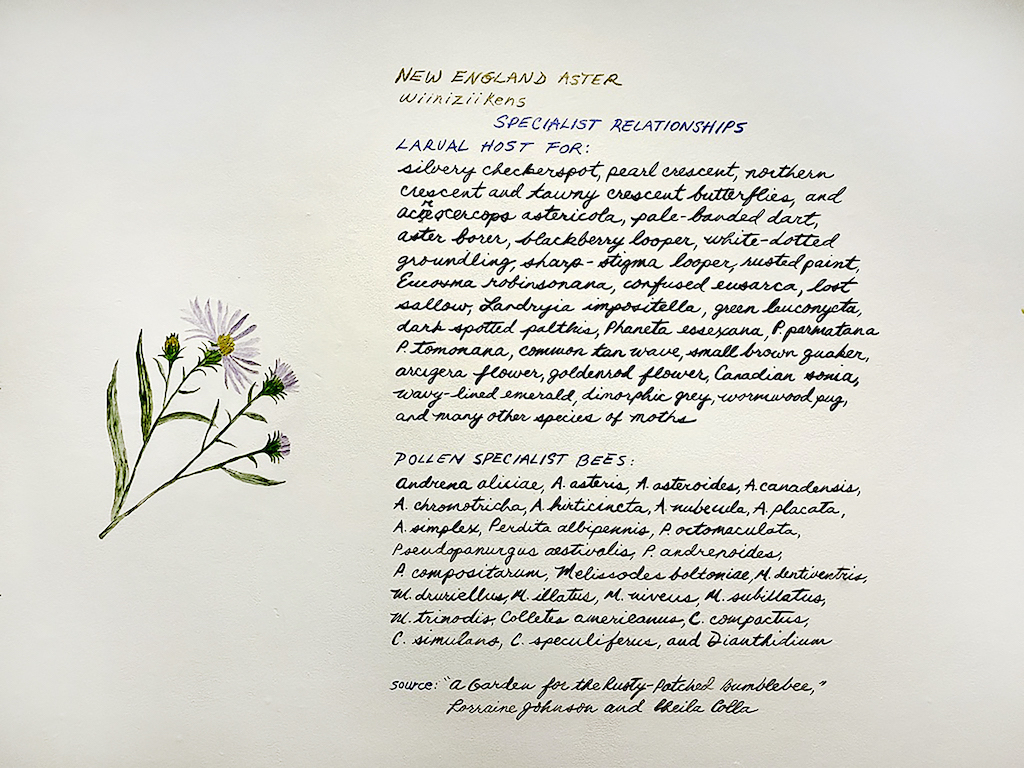
There are delicate illustrations of these two plants interspersed alongside the texts, painted directly on the wall with handmade artist inks from Manitoulin Island. Also, painted in a lovely chicory blue colour, there is a rendering of a poem by Zetlin called There is no ‘it’ for nature – Robin Wall Kimmerer that extols how language robs the named of its integrity of being a full “kin” in the family of being – “with a life force, agency, and intelligence.”
On an opposing wall is the title panel for the show with the requisite information announcing the exhibition. Usually placed on the wall in laser-cut vinyl lettering, this signage reveals itself, upon closer inspection, to be entirely rendered by hand with all the charming vagaries of line and edge that come with human intervention. This rejection of pristine, mechanized precision gives the title, More Than Human a conceptual depth and resonance.
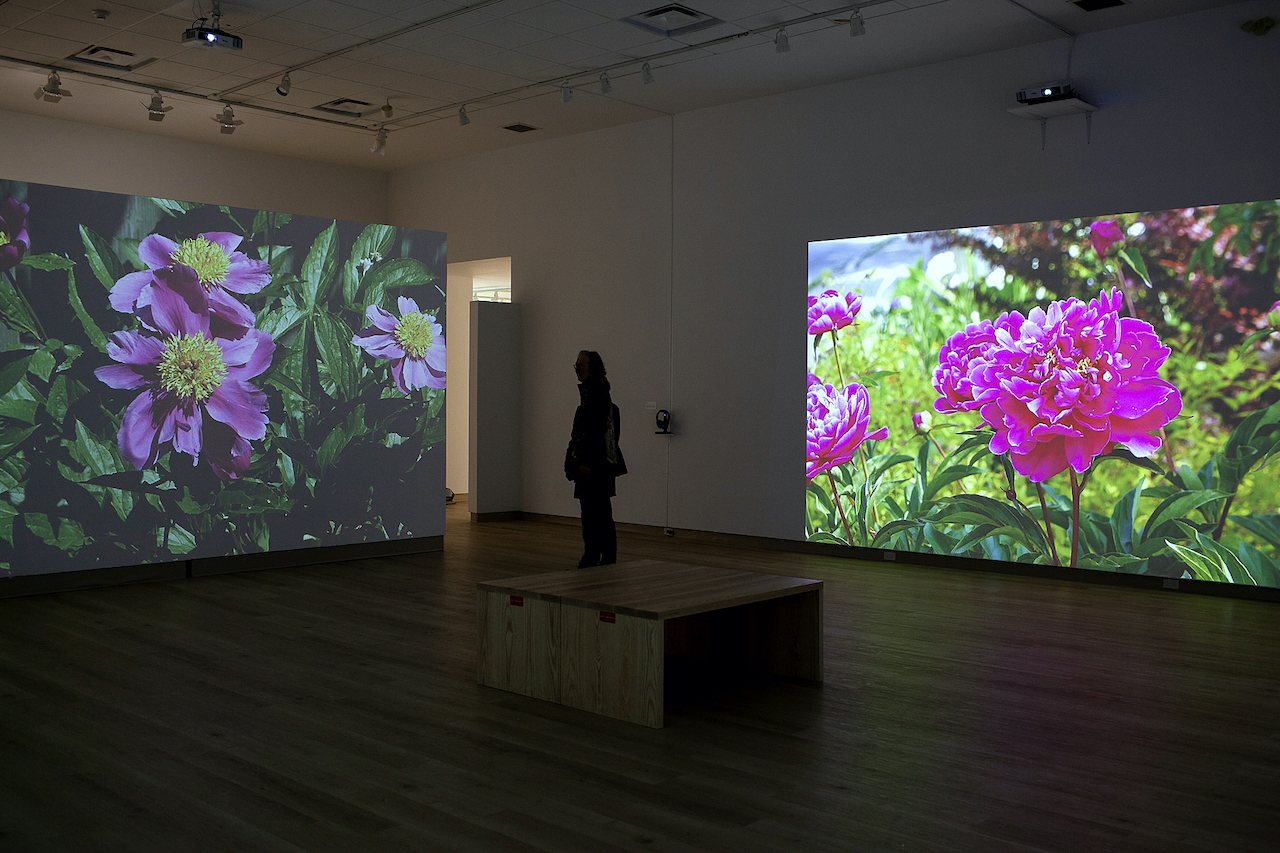
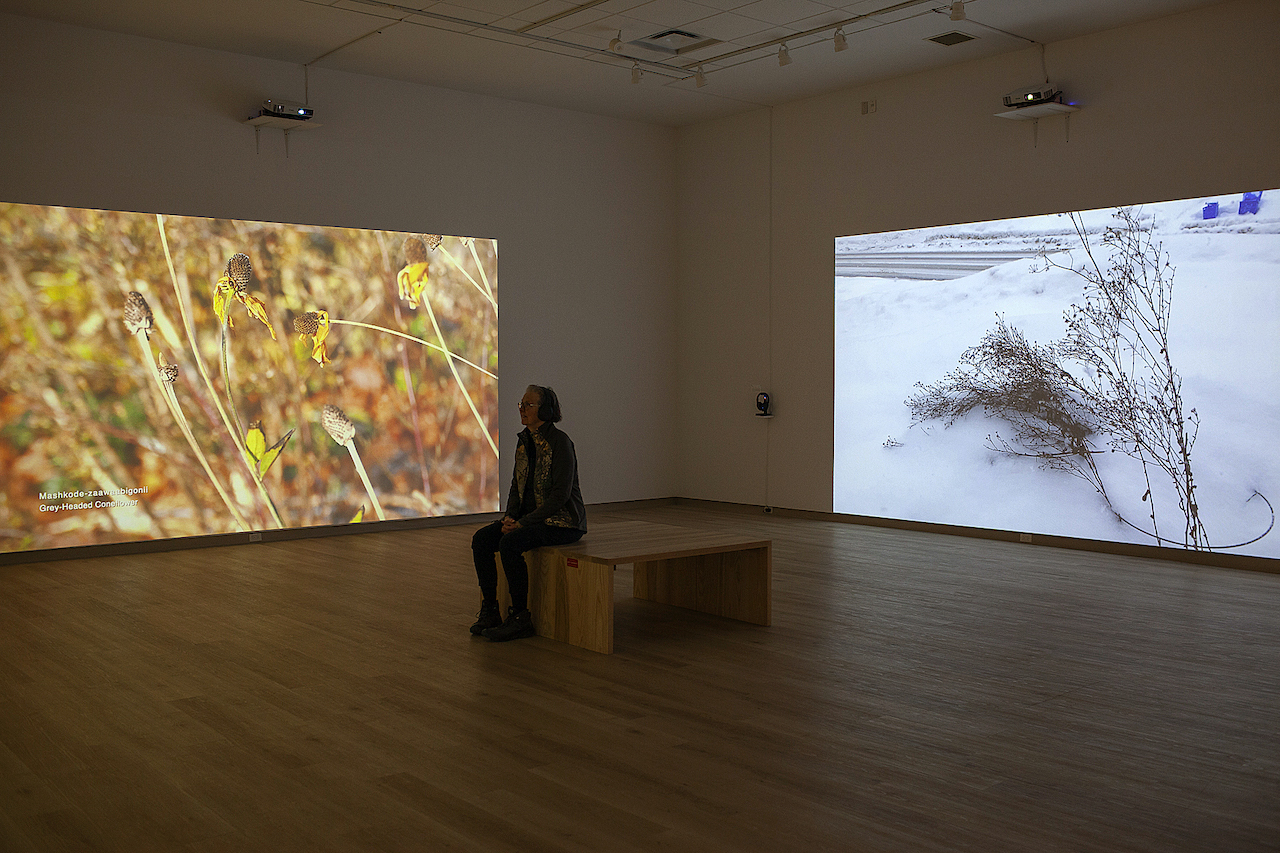
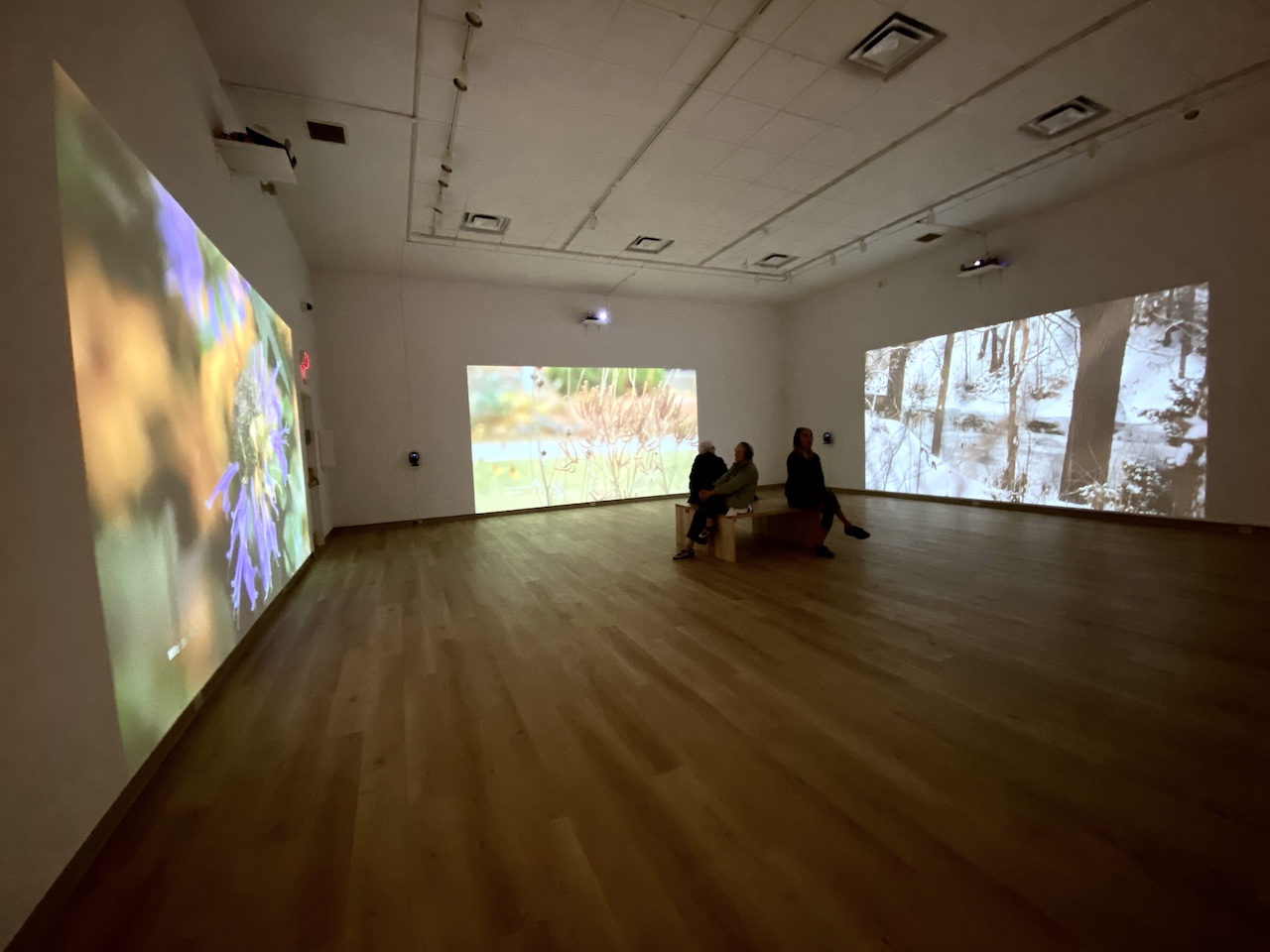
Around the corner, the main exhibition space of More Than Human unfolds as a kaleidoscopic field of four large-scale video projections, each scaled to the limits of the gallery itself. There is one video for each season and an accompanying soundtrack that can be accessed through headphones, one for each of Winter, Spring, Summer, and Fall.
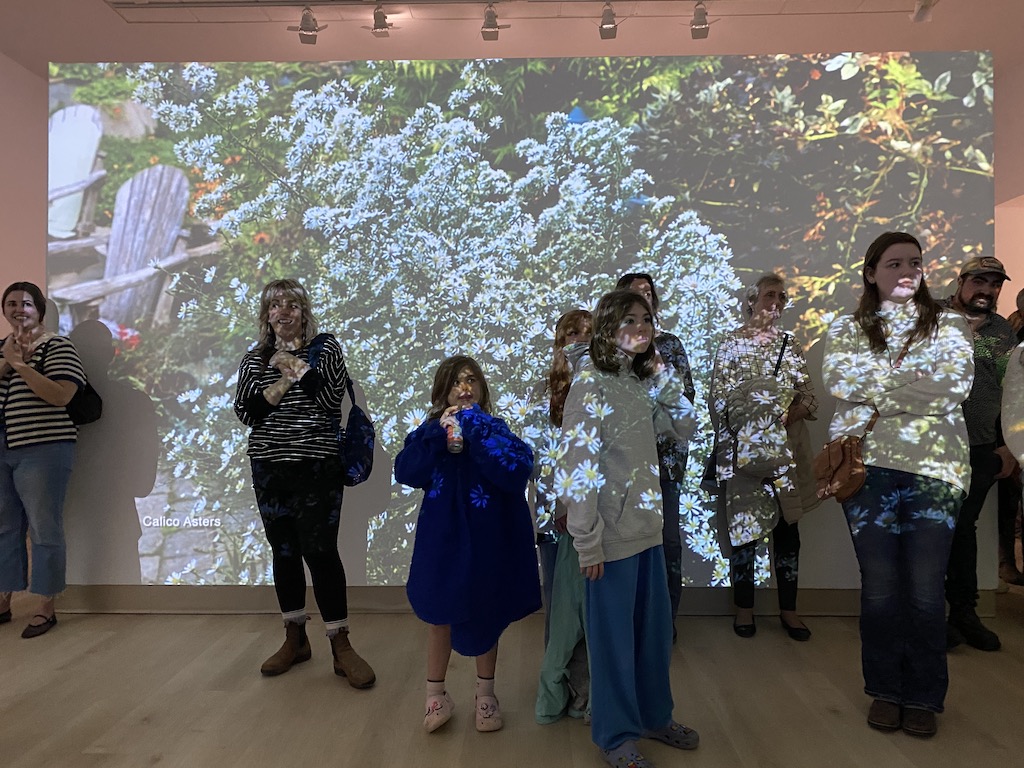
Within the light well of the show, it is difficult to focus on any single projection because of their proximity to one another. One’s shadow is superimposed upon the imagery of the garden as you move around the room – a dramatic intersection and a powerful metaphor.
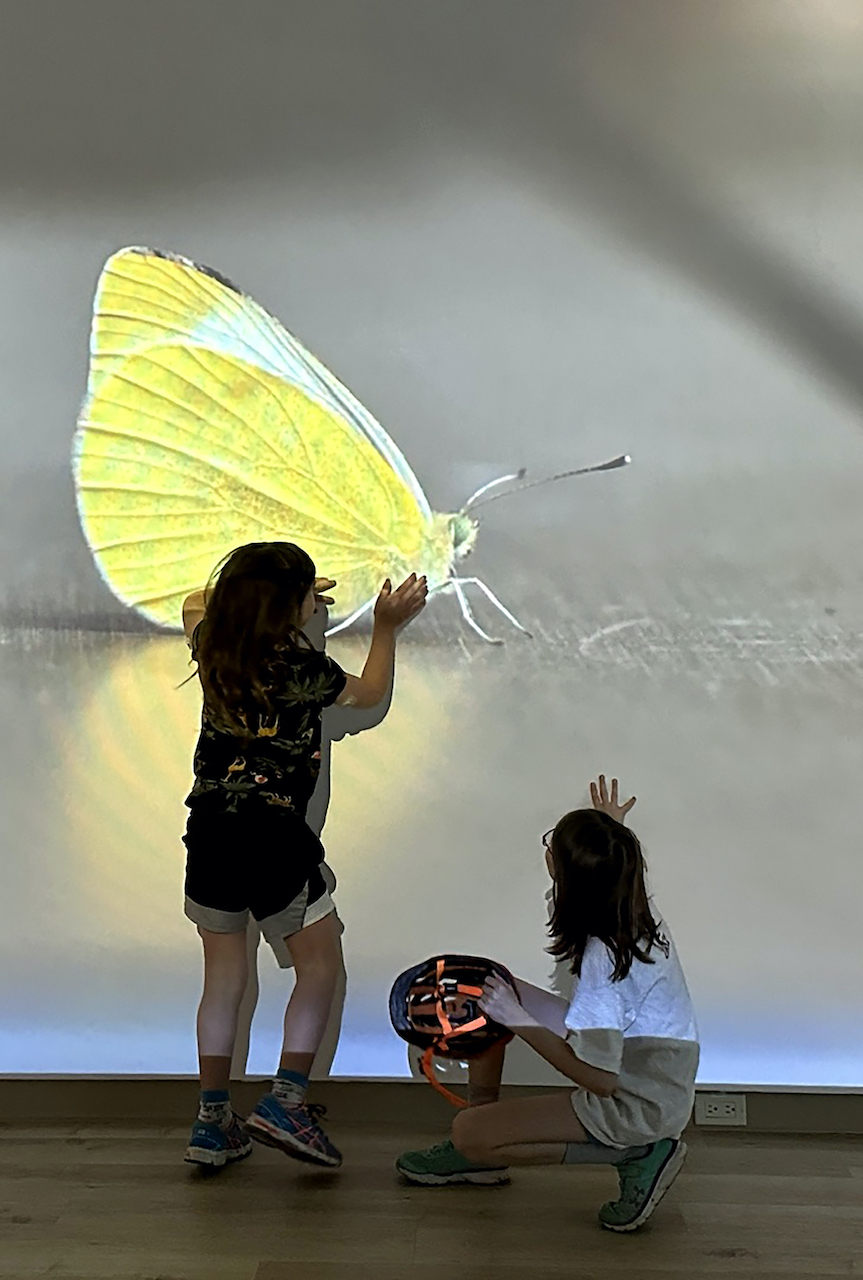
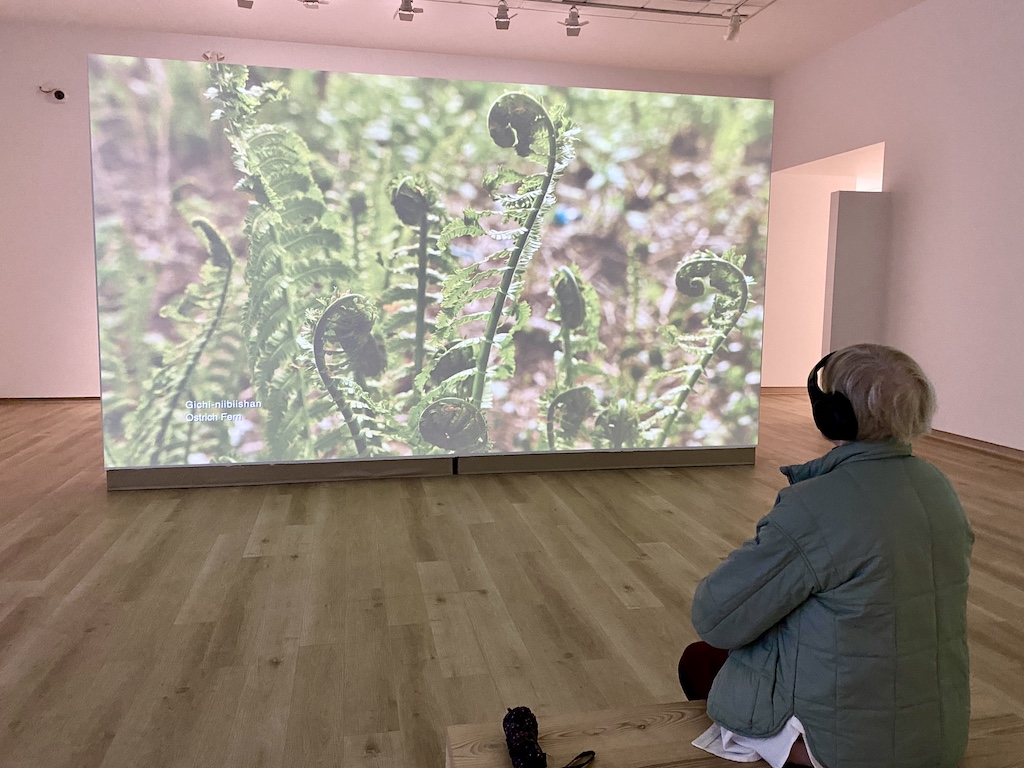
Scale is a tool that the artist has considered very carefully. The magnification of the garden imagery renders everything – leaves, branches, blossoms, butterflies, and insects – far larger than life-size and perfect for close inspection. Our human scale, so often associated with dominion over the landscape, is suspended; we look and listen to the garden from a Lilliputian perspective. What we glimpse is a diversity of life and activity that is often overlooked.
As someone who worked in art museums for decades, the irony of prompting ideas like this in the hermetically sealed, climate-controlled, untouchable gallery environment is subversive, as I see it. We cannot engage with the full sensuality of what is visually presented: smells, textures, tastes, and temperatures remain beyond our reach.
Museums exist to preserve collections, suspending time and ensuring objects last in perpetuity. This unnatural arrest of time and the delay of organic
decay mean that the museum would not welcome in any of the organisms we are observing. In fact, such interlopers are dangerous to the concepts of preservation. A moth in a museum vault can be a catastrophe – even a bump in humidity can set off the alarms. Viewers of nature within a museum are steps back from the occurrence of a fully sensual natural experience. Is there a warning here about how we may interact with nature in the future, as corporatization and the systemic commodification of everything continue their unchecked march toward ecological collapse?
The didactic nature of this show orders us to stop and look at this. Contemporary distraction has weakened our ties to nature and eroded the innate understanding that we are part of a greater whole. The life force evident in every season of this urban garden is testament to the burgeoning activity that surrounds and supports us. Everything is interconnected and the vulnerability of our present moment is inseparable from the precarity of the beings whose existence collides with human activity.
Zetlin weaves the buzzing interference of contemporary life in the sounds of nearby traffic, a plane overhead, the white noise of the urban infused the soundtrack. One is conscious that these native plants we observe are displaced from their own wild habitat, replanted within the walled garden that becomes an oasis in an urban and hostile cityscape. Still, reassurance can be found in the infiltration of the pollinators and insect inhabitants that do their thing anyway. Life goes on around us, and sometimes despite us.
There is a stark, yet poetic realization garnered from this mediated evocation of Zetlin’s garden. We are no longer part of the garden – we have expelled ourselves from the realness of experience just like the Biblical expulsion from Eden.
What the artist shows us through the lens of mediation is the distance between our intellectual perceptions and true oneness with nature. From this purgatory of separation, we glimpse that the embrace of unity, finding our place in the family of all creatures, is the antidote to the anxiety of our contemporary culture. Stopping, breathing, grounding ourselves, brings us into mindfulness, and the reassurance of surrounding life.
Our own preservation can only be assured when we break down the garden walls and welcome in the full organic rush of nature’s complexities. Moving beyond a singularly human perspective, we might expand our consciousness toward a state of oneness, becoming more fully aware of the interbeing of all.
Written by Stuart Reid
Photos by Liz Zetlin, Joachim Ostertag, Becky Comber, Dawna Proudman
Stuart Reid studied art and art history and is a graduate of York University, Toronto. Reid has over 35 years of leadership experience in the non-profit sector, having served as art museum director and curator of contemporary art at galleries in Ontario and Saskatchewan. He is an award-winning writer of more than sixty publications and exhibition catalogues. He joined the community philanthropy movement in 2016 as Executive Director of Community Foundation Grey Bruce. Reid is a certified registered yoga instructor (CYA-RYT-EGOLD).
- https://www.biologicaldiversity.org/programs/biodiversity/elements_of_biodiversity/extinction_crisis/
- Pollan, Michael. Second Nature: A Gardener’s Education. Atlantic Monthly Press, 1991.
- Johnson, Lorraine, and Sheila Colla. A Garden for the Rusty-Patched Bumblebee: Creating Habitat for Native Pollinators. Douglas & McIntyre, 2022.